Understanding the Contractor Cash Cycle: Why Profitable Projects Can Still Create Cash Flow Problems
Many outdoor living contractors don't struggle because they lack work. They struggle because they run out of cash.
As projects grow larger and businesses become more complex, contractors often find themselves paying for materials, labor, and overhead weeks before collecting the final payment from the customer.
Understanding how cash moves through a project is one of the most important financial skills a contractor can develop. In this article, we'll walk through the contractor cash cycle and explain why profitable projects can still create cash flow stress.
Understanding the Cash Cycle
Most projects follow a similar pattern. Understanding when cash enters and leaves your business can help you identify potential cash flow problems before they become serious.
Contract Signed
The project is sold and the agreement is signed. At this point, no cash has changed hands, but the business has committed to taking on the work.
Initial Deposit Received
The customer pays a deposit to fund the start of the project. This cash often helps cover initial material purchases and other upfront costs.
Materials Purchased
As materials are ordered and delivered, money begins leaving the business. Depending on the project, these purchases can represent a significant portion of the total project cost.
Labor Costs Accumulate
As work progresses, labor costs begin to accumulate. Employees need to be paid regardless of whether customer payments have been received.
Progress Billing
On larger projects, you should be billing progress payments. These payments can help reduce cash flow pressure by bringing cash into the business before the project is complete.
Project Completion
The work is finished, but final payment may not be collected immediately. Depending on the customer and billing process, this delay can create cash flow pressure for days or even weeks.
Final Payment Received
The remaining balance is collected and the cash cycle for that project is complete.
Example Cash Flow Timeline
Contract Signed
↓
Initial Deposit Received (+$5,000)
↓
Materials Purchased (-$7,000)
↓
Labor Costs Incurred (-$4,000)
↓
Progress Billing Received (+$3,000)
↓
Project Completed
↓
Final Payment Received (+$12,000)
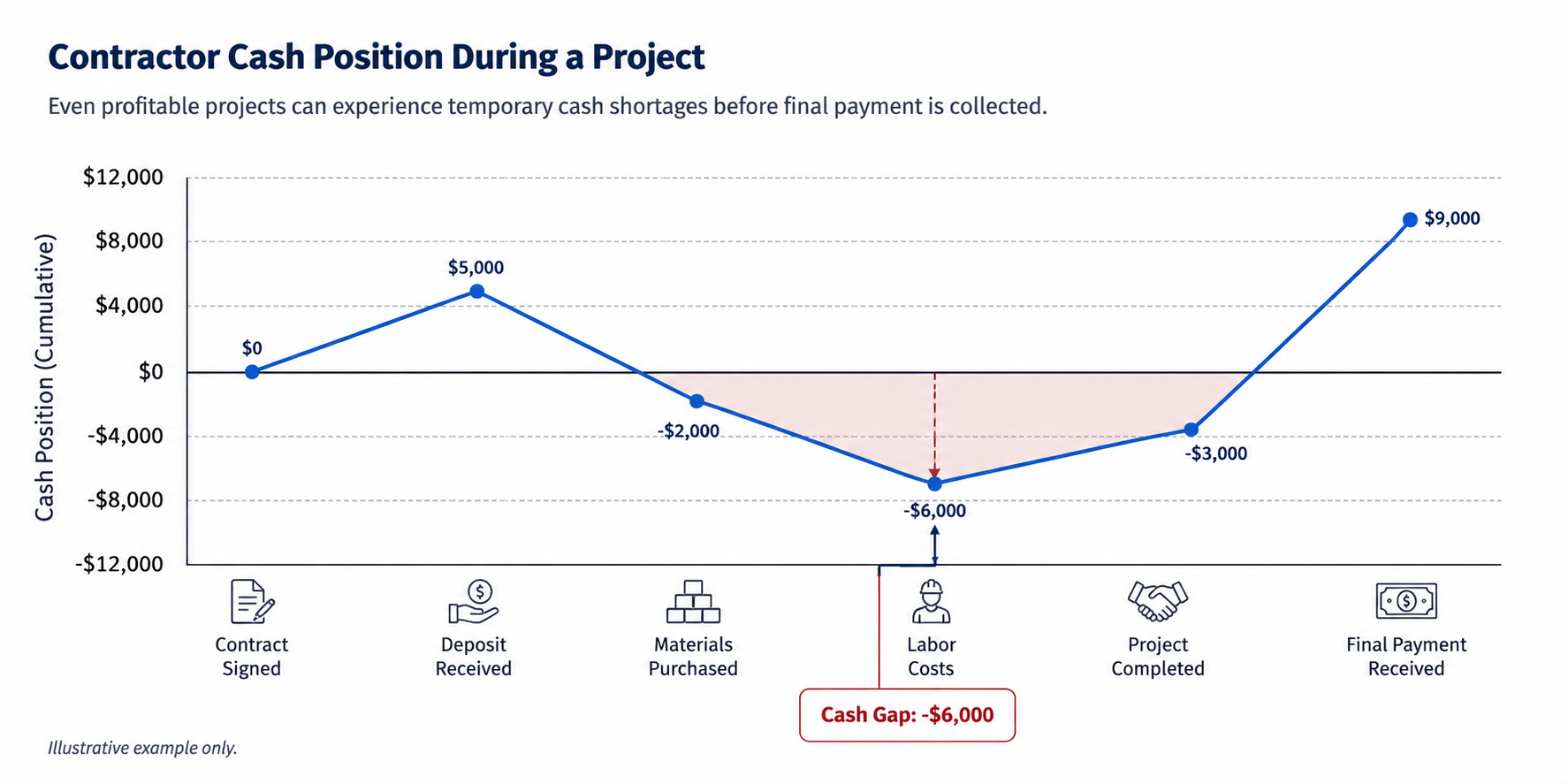
In this example, the project ultimately generates $9,000 of positive cash flow. However, before the final payment arrives, the contractor is $6,000 in the hole.
This period is often referred to as the cash gap. The larger the project, the longer the project duration, or the smaller the deposit collected upfront, the larger this cash gap can become.
The important thing to notice is that cash often leaves the business before all customer payments are received. This timing difference is what creates cash flow pressure, even when a project is ultimately profitable.
Why Cash Flow Problems Happen
Understanding the cash cycle is only the first step in identifying issues. Cash flow problems often arise when one or more of the following issues are present in the cash cycle.
Underbilling
Initial deposits and progress payments may not be large enough to cover project expenses as they occur.
When this happens, the business effectively finances part of the project itself. As projects become larger, this can place significant pressure on cash reserves.
Delayed Collections
Customers who do not pay according to agreed-upon terms can create cash flow problems quickly.
Even profitable projects can strain cash flow if payments arrive weeks later than expected.
Overhead Expenses
Even when a project is profitable, overhead expenses such as insurance, vehicles, software, rent, and administrative costs continue regardless of where the project stands in the cash cycle.
Many contractors focus on project costs while overlooking the impact that ongoing overhead expenses have on available cash.
Delayed Billing and Inconsistent Follow-Up
Waiting too long to send invoices after milestones are completed can delay collections unnecessarily.
Similarly, inconsistent follow-up on outstanding invoices can cause payments to arrive later than expected.
Change Orders
If change orders are not properly documented and billed, the contractor ends up funding that additional labor and material with no corresponding payment, adding to the cash gap at exactly the point in the project when cash pressure is often highest.
Growth
Growth can also create additional cash flow pressure.
Taking on more projects typically requires more materials, more labor, and more overhead before additional customer payments are received.
Many contractors are surprised to discover that growing revenue can actually create short-term cash shortages.
Practical Ways to Improve Cash Flow
The good news is that many cash flow problems are preventable.
Review Deposit and Draw Schedules
Make sure deposits and progress payments align with the timing of project expenses.
The goal is to not finance projects out of your own pocket when it can be avoided.
Set Clear Payment Terms
Establish payment expectations upfront and follow up consistently on outstanding invoices.
The faster you collect, the less pressure is placed on your cash reserves.
Account for Overhead in Your Cash Planning
Project profitability is important, but overhead expenses still need to be paid.
Building these expenses into your cash planning process can help prevent unexpected cash shortages.
Document and Bill Change Orders Promptly
Additional work should be documented and billed as soon as possible.
Delays increase the likelihood that your business ends up financing the work.
Prepare for Growth
If you anticipate taking on additional projects, plan ahead for the additional cash demands that growth creates. This may involve building cash reserves, securing a credit facility, or taking a more measured approach to expansion.
Financing options are often easier to obtain before cash flow becomes a problem.
Forecast Upcoming Cash Needs
Even a simple four-to-eight-week cash forecast can help identify upcoming cash shortages before they become emergencies.
A little visibility can provide valuable time to make adjustments and avoid surprises.
Final Thoughts
Cash flow problems don't have to be a normal part of running a contracting business.
With the right billing structure, clear payment terms, and a basic understanding of how cash moves through your projects, many of these issues can be prevented.
If you're finding it difficult to keep up with cash demands as your business grows, or you're not sure where to start, it may be time to take a closer look at your cash flow processes.
We work with outdoor living contractors to improve visibility into profitability, cash flow, and overall business performance.
If you're experiencing cash flow pressure, aren't sure whether your deposit structure is working, or want a clearer picture of how cash moves through your projects, we'd be happy to talk.